


When I decided I wanted to build a cafe racer, I knew I wanted something with real power, that would be fun to ride, but also with the right lines to look the part.
The 1978 Suzuki GS1000 was Suzuki's first literbike, introduced into a field that already included the Yamaha XS11 and the Honda CBX. It was lighter than most of its competitors, made around 90 horsepower from the factory, and went on to earn a legitimate racing reputation, Wes Cooley won back-to-back AMA Superbike Championships on a Yoshimura-prepped GS1000 in 1979 and 1980. It was a serious machine dressed up in plain clothes.
But what got me was the tank. The GS1000 has one of the best tank lines of any motorcycle from that era, long and flat with a shape that pulls your eye from the headlight all the way back. Suzuki got that one right. I knew it had the right bones to build from.
I found it on Craigslist in the summer of 2015. Silver, surprisingly clean for its age. The previous owner had put a Vance & Hines exhaust on it and otherwise left it alone. It ran well. The chrome was decent. By any reasonable measure, it was a good bike.
I had no real plan. I'd never done a build. I didn't have a fabricator on speed dial or a mentor who'd done this before. I had a garage, some tools, an internet connection, and a general sense of what I wanted it to look like when I was done. That turned out to be enough, most of the time.
The First Thing I Did Was Wrap the Exhaust
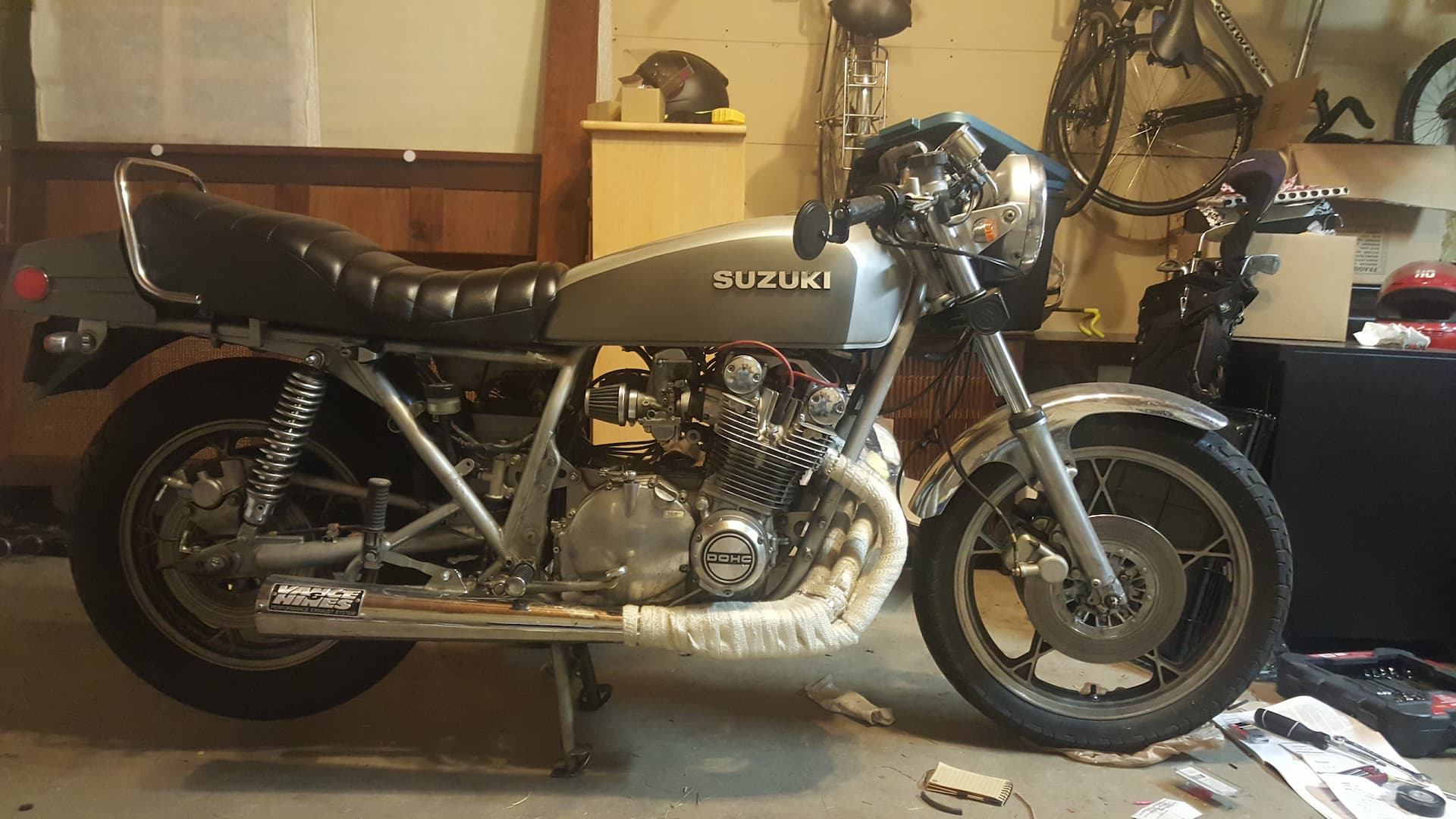
The exhaust wrap went on first, which tells you something about where my head was. I wasn't starting with a plan, I was starting with the detail that bothered me most. The chrome collectors looked wrong against what I was imagining for the rest of the bike. Wrapping them in tan heat wrap was cheap, immediate, and it started making the bike look intentional instead of stock.
I flipped the handlebars to drop the stance, and the bar-end mirrors went on around the same time. Small changes, but they shifted the silhouette enough that I could start seeing what the bike wanted to be.
Clip-Ons and Gauges

The original bars came off and clip-ons went on. If you've never ridden clip-ons on a bike not designed for them, it's a commitment. The riding position changes completely, weight forward, lower, more aggressive. On a liter bike from 1978 with no modern suspension tuning, it's not exactly comfortable on a long ride. That wasn't the point.
I also switched out the gauges. I wanted to get away from the large, black, boxy cluster that the original had. I used this smaller chrome set for a while before switching it out later.
The Seat Was the Hard Part

The stock seat on a GS1000 is long. It has to be, because all the electronics, the battery, the regulator, the fuse block, everything lives in a plastic housing mounted to the rear frame triangle underneath it. If you want a short cafe seat, you have to move all of that somewhere else. And if you move it somewhere else, you have to build something to put it in.
I found a short brown leather cafe seat I liked and started dry-fitting it. You can see in this photo that the old black electronics housing is still in place, the seat just floating above it. Getting from this to finished required cutting the frame, building a new box, and relocating everything.

I took it to a shop to have the frame cut. I wasn't about to run a grinder through structural steel on a bike I was going to ride without knowing exactly what I was doing. That part I outsourced. The box I built myself, cutting sheet metal, bending it, making do with whatever pieces worked. It wasn't pretty on the inside. It didn't need to be.

Once the seat was mounted and the electronics were relocated into the new box under it, the rear triangle opened up. That was the moment the bike became what I'd been picturing. An open frame, no plastic, no housing, just tubes and air. The brown leather seat sitting above it, the tank in front of it. It looked right.
The Electrical Work

At this point I switched to a Koso gauge with a digital speedometer. Moving the electronics sounds straightforward until you're looking at a 1978 wiring harness and trying to figure out where everything goes in a space half the size of what it came from. I spent a lot of time with a wiring diagram and a lot of time guessing. The red, blue, and yellow wires running through the open frame in this photo represent maybe three or four sessions of figuring it out, routing everything, testing it, re-routing when something didn't work.
Old bikes are forgiving in this regard. The electrical systems are simple compared to anything modern. But simple doesn't mean obvious when you're learning as you go.
I Was Riding It the Whole Time

This wasn't a build I completed and then started riding. I was riding the GS throughout the whole process, sometimes with things still half-finished, checking what worked and what didn't. For a stretch I was commuting on it to law school, and to an internship at a small personal injury firm where I was getting my first real exposure to PI work.
That internship is where I first noticed that not every PI attorney shared my enthusiasm for motorcycles. Some of them understood riders. A lot of them didn't. They saw motorcycle cases as complicated, or they saw riders as at least partly responsible for whatever happened to them. I filed that away. It would come back to me later.
Red Rocks

The X-tape on the headlight is a cafe racer tradition, borrowed from road racing where you tape the glass so it doesn't shatter across the track if it breaks.
This photo was taken not long after the seat went on. The new Koso gauge was just installed, the rear triangle still had some cleaning up to do, but I was making progress. In Denver we're incredibly lucky to have these amazing places to ride in our backyard.
Mount Evans

I took it up Mount Blue Sky (formerly Mount Evans) at some point, which is not something a sensible person does on a 40-year-old bike with no windscreen and clip-ons. The road has enough exposure to keep you honest, and at altitude the engine starts to feel the thin air. I made it to the top. The view with that bike in the foreground is one of my favorite photos.
The Front Fender

Near the end I cut the front fender for a shorter look. The stock fender was too large and too stock-looking for where the rest of the bike had gone. A small change at the end, but the right one.
Finished


The bike photographed well in almost any setting, but something about the flat water and the Colorado sky made the matte tank and the exposed frame look exactly right. Ultimately, it was all about that gas tank line.
Build Summary: What Changed on the 1978 GS1000
For anyone looking for the specifics, here's what was modified on this build:
- Exhaust wrap: Tan/khaki heat wrap over the stock four-into-two headers, keeping the Vance & Hines collector
- Handlebars: Stock bars flipped to drop stance, then replaced with clip-ons
- Mirrors: Bar-end mirrors replacing stock stalks
- Seat: Short brown leather cafe/bobber unit replacing the long two-up stock seat
- Frame: Rear loop cut and modified by a shop to accept the new seat profile
- Electronics relocation: Battery, regulator, fuse block moved from rear triangle housing into a custom sheet metal box under the new seat
- Gauge cluster: Replaced with a Koso gauge
- Front fender: Cut for shorter look
- Engine: Stock
No engine work. The GS1000 DOHC inline-four doesn't need it.
There are various random other bits and pieces that I did during the build, but these were the ones that stood out.
Why I'm Writing This
I didn't document this build in real time because it didn't occur to me to. This was 2015, before everyone was a content creator, before build threads were a common genre. I was just having fun working on a bike in my garage, figuring things out, sometimes getting it right on the first try and sometimes not.
I think about that process a lot in the context of how I practice law. You don't always know the answer before you start. You find a direction that looks right, you start moving, you adjust when something doesn't work. You ask for help on the parts that require expertise you don't have, and you do the rest yourself.
And like building a cafe racer, a personal injury case requires oversight from beginning to end. Even when you don't know what the ending is going to be, the early stages and the small details have to be done right. You have to set a foundation to build on. I treat every case as if it's going to trial, because you never know what's going to happen, and if you aren't prepared for trial from the beginning you're going to run into problems when you get there. I've filed over 300 lawsuits and taken cases to verdict. I know the difference between a case that settles and one that needs to be tried, and I know how to build the kind of case that gets the right result either way.
The attorneys who do well for their clients aren't always the ones with the biggest billboards or the most TV spots. They're the ones who actually understand what a case requires, and who are willing to do the work.
If you've been in a motorcycle accident in Colorado, I'd like to talk to you. Not because I can promise an outcome, but because I understand what you're dealing with and I know how to fight for what your case is actually worth.
877-2929-LAW | venyxlaw.com
Dylan Unger is the founder of VENYX Injury Law, a Denver-based personal injury firm. He has been riding motorcycles his entire life and is the 2023 MRA Novice GTU Season Champion.


